

Research reviewed and updated: 23 September 2026
If your business has ever commissioned software, you know the estimate. A new customer portal, an integration with the finance system, a change to an internal application: someone works out how many developers are needed and how long they will spend writing code. Cost follows from that.
That assumption is beginning to break.
AI tools are no longer used only to suggest the next few lines. Developers are handing whole pieces of work to coding agents. The agent inspects the application, reads the instructions, modifies many files, runs the tests, investigates failures and returns a proposed solution.
The tools move quickly. On 21 September 2026, GitHub announced another Copilot model positioned for agentic coding and multi-step workflows. It was one release among many this year. It shows how fast the major platforms are moving from assistance towards autonomous execution.
The more useful story is not what the tools can do. It is what developers now do differently because of them.
AI is already writing a meaningful share of software. The developer's value has moved.
JetBrains surveyed more than 15,000 professional developers between May and July 2026. It found that 90% were using AI coding agents at work at least weekly, and 68% every day.
The same research shows how much work has moved. Developers reported that about 47% of their code was fully generated by agents, with a further share written with AI assistance. Around 22% said more than 80% of their code was agent-generated. These are self-reported figures and should not be read as a precise measure of every organisation. The direction is hard to argue with.
This is not a story about junior developers who cannot code. JetBrains found that about a quarter of senior developers were among those generating more than 80% of their code with agents.
That changes the conversation. If an experienced developer can ask an agent to produce most of an implementation, that developer's value is no longer measured by typing speed. The valuable work happens before the code is generated, and after.
The hours saved on coding are not returned to the business. They move.
BairesDev's Q3 2026 Dev Barometer surveyed 705 developers across more than 60 countries in August. It found that 42% said at least half of their code was now AI-written, up from 12% a year earlier. Developers estimated AI saved them an average of 13 hours of coding time a week, with a median of 10.
Thirteen hours is almost two working days. Those hours have not come back to the company.
The same study found that 51% of developers were spending more than a quarter of their week reviewing AI-generated work, and 67% were spending more time reviewing it than a year earlier. Fifty-eight percent reported greater accountability for code they had not fully written.
The work is moving.
It used to run: - requirement - developer designs the solution - developer writes the code - developer tests the code - release.
It increasingly runs: - Business requirement - Then intent - Constraints and architecture set by the developer - The agent generates or modifies the software - Automated tests and checks run - The developer reviews, challenges and corrects - Security and quality validation follows - Then human approval - Finally, release.
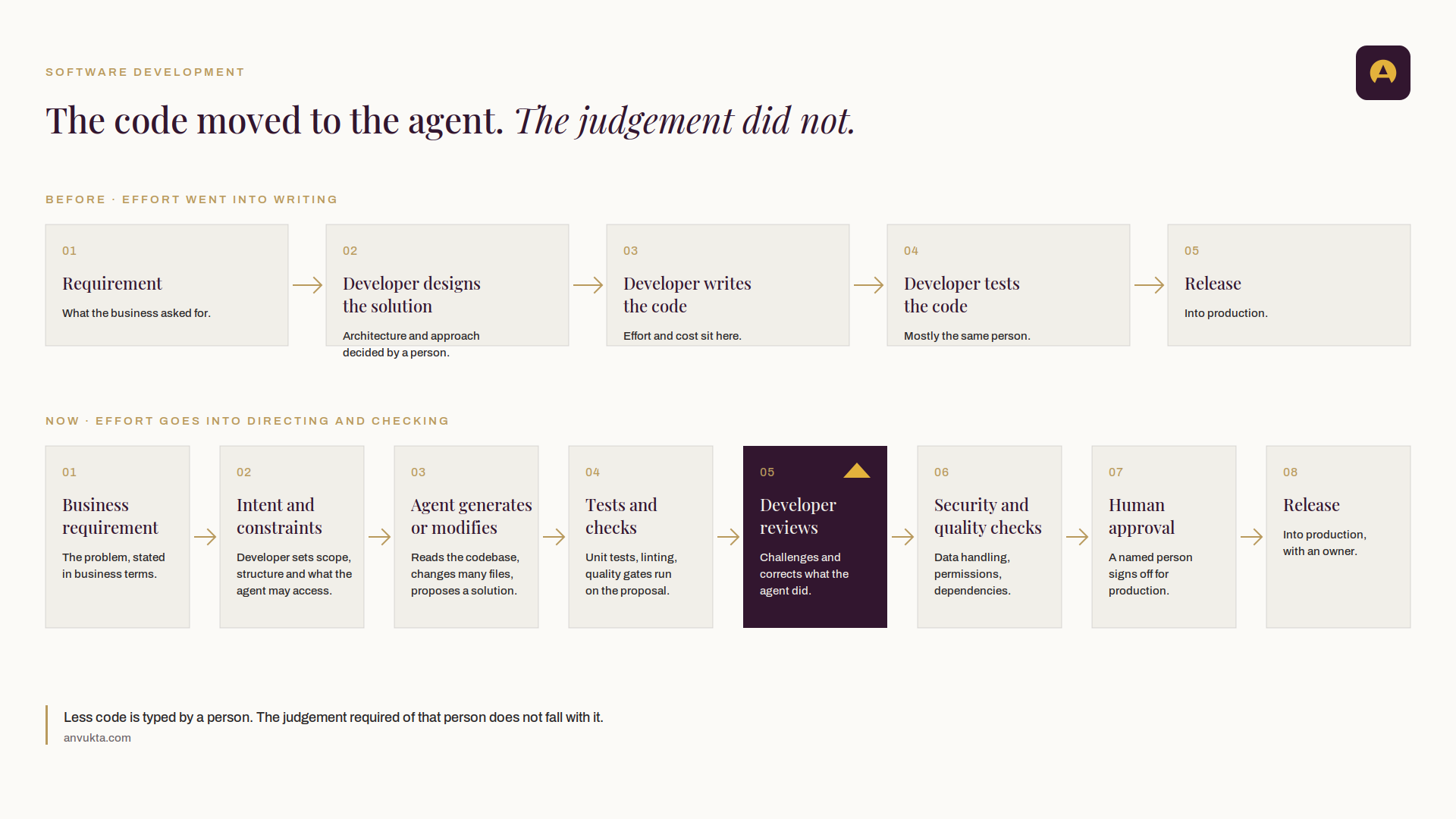
The amount of code a person physically writes may fall a long way. The judgement required of that person does not fall with it.
"Almost correct" software is still incorrect software. That is the SMB's problem.
Software rarely fails in the obvious place.**
A registration page can look perfect while storing the wrong consent information. A pricing engine can handle 99% of transactions and mishandle one unusual discount combination. An internal system can run well until two employees from different departments receive permissions they should not have.
AI produces plausible code quickly. Plausible is not the same as correct.
BairesDev found that 59% of developers reported greater mental effort to catch subtle bugs in AI-generated code, and 52% were spending more time debugging problems that AI introduced. Forty-one percent said almost no AI-generated code reached production without specific human review.
The defining skill of an experienced developer may become this: recognising when apparently good software is quietly wrong. For an SMB, that matters far more than whether an agent can produce a feature in twenty minutes.
So what does a developer do now? Direct, inspect, and stay accountable.
The role now sits between engineer, reviewer and technical manager. A capable developer increasingly needs to do nine things.
- Translate a business problem into clear technical instructions. - Decide how the system should be structured before asking AI to build it. - Choose what an agent is, and is not, allowed to access. - Inspect generated code rather than assume it is correct. - Design tests around real business situations, not only technical happy paths. - Check security, data handling and permissions. - Understand the dependencies and third-party components the AI introduced. - Decide whether another human can maintain the result later. - Remain accountable for what reaches production.
This is a more demanding role, not a less demanding one. Writing a function needs programming knowledge. Supervising an agent that changes twenty files across an unfamiliar application needs programming knowledge plus architecture, context, judgement and the ability to investigate what the agent did.
Why this should interest an SMB owner. The build-versus-buy sum has changed.
The main opportunity for smaller businesses may not be cheaper coding. It may be access to software that was previously uneconomical to build.
McKinsey's August 2026 State of AI survey found that about one in five organisations were already scaling software coding agents. Thirty-two percent said they had decided not to purchase at least one software product or feature because they could build it internally with agentic coding tools.
Consider a growing business that needs a specialised operations dashboard. It used to have three realistic choices. Buy an off-the-shelf system and bend its processes to fit. Commission expensive custom software. Or carry on in spreadsheets. AI-assisted development adds a fourth: a small experienced team, supported by coding agents, building exactly what the business needs.
That does not mean every SMB should build its own software. Buying an established system is still the better choice when the requirement is common and the integrations already work. It is also better when custom maintenance would add complexity nobody wants. But AI has reduced the effort behind some custom solutions, so decisions that used to be obvious deserve a second look.
The bottleneck is moving from coding to control. Measure the right thing.
The easiest mistake is to measure AI development by how quickly the first version appears.
If coding becomes much faster while testing, security review, integration and approval stay unchanged, those activities become the new bottleneck.
Budgets already show it. In the BairesDev survey, 78% of the 41 CTOs surveyed had increased investment in code review, quality assurance or validation infrastructure in the previous year to support AI-generated work. The CTO sample is small and should not be generalised, but it is consistent with what developers reported: more code can be produced, so more code has to be checked.
The question for an SMB introducing AI development is therefore not "How much faster can AI make our developers?"
The better question is "How much more software can we safely manage?"
Those are not the same thing.
The change will not look identical everywhere. The management questions will.
Adoption is uneven. JetBrains found that about 16% of developers in Europe and the UK were generating more than 80% of their code with agents. In the United States, Claude Code alone was used at work by 47% of professional developers surveyed. In India, 15% of developers surveyed were using Google's Antigravity at work by mid-2026.
Comparable UAE-specific data for 2026 is thin, and we will not invent a percentage. For UAE businesses the lesson is the international trend: companies that buy or build software need to understand how AI is being used by their own developers, their contractors and their technology suppliers.
Whether the business operates in Dubai, London, New York or Bengaluru, the management questions are the same. Who reviews the code? What can the AI access? Who approves production changes? How are failures traced? Who is accountable when the system behaves incorrectly?
Do not hire people simply to write code. Hire people who can manage software.
That is the most practical conclusion for an SMB planning its technology capability today.
A developer who is excellent at producing code by hand but weak at understanding business problems, architecture, testing and AI-assisted workflows may become less valuable. A developer who understands the business, knows how good systems are designed, can direct AI and can spot where it went wrong may become considerably more productive.
Software development is leaving a world where human effort limits how much code can be created.
Code is becoming easier to produce. Reliable software is not.
The developer's new job is to manage that difference. AI may write a growing share of the software your business runs on. Someone still needs to understand what it wrote, why, whether it is safe, and whether it solves the problem you actually had.
For a small or mid-sized business, that person may now be more important than ever.
If you are deciding whether to build, buy, or let a supplier use AI on your systems, the missing piece is often someone who sets the controls before the code is written. We will listen and tell you honestly whether we can help.
Tell us what is happening ↗ https://www.anvukta.com/enquire
See the gap. Find the missing piece. Bring clarity.
Does this sound familiar?
Tell us what is happening in your business. We will listen and help you identify the next useful step.
Discuss this with us ↗